OCD and substance use in Louisville often share a pattern that is easy to miss, because obsessive-compulsive disorder (OCD) and addiction both run on a loop of distress followed by quick relief. If you or someone you love lives with intrusive thoughts and has started relying on alcohol or drugs to quiet them, you may feel exhausted, embarrassed or unsure who to tell.
The thoughts may arrive uninvited and refuse to leave. Checking, counting or seeking reassurance may take up hours of your day, and a drink at night may be the only thing that slows your mind down.
Many people navigating OCD and substance use in Louisville have kept these struggles private for years. None of this means you are weak or broken. OCD is a real health condition, and reaching for relief is a very human response to constant distress.
Both conditions respond to care, especially when one team treats them together. You do not have to figure this out alone.
What Is OCD and How Does It Show Up?
OCD is a mental health condition marked by obsessions and compulsions. Obsessions are unwanted, distressing thoughts. Compulsions are repeated actions or mental rituals done to ease that distress. OCD is not about being neat or liking things a certain way.
The National Institute of Mental Health describes OCD as a long-lasting condition that can interfere with work, school and relationships. Many people recognize that their thoughts are excessive but still feel unable to stop the rituals.
Effective care for OCD and substance use in Louisville starts with understanding how these symptoms show up in daily life.
What Do Obsessions and Compulsions Look Like?
Obsessions and compulsions look different for everyone, though some patterns are common. You may notice signs like these:
- Fears of germs or contamination that lead to repeated washing or cleaning
- Doubts about safety that lead to checking locks, stoves or doors again and again
- Unwanted violent, sexual or religious thoughts that bring intense guilt
- A strong need for things to feel “just right,” often with counting or arranging
- Mental rituals, such as repeating phrases or replaying conversations
- Asking others for reassurance many times a day
Intrusive thoughts do not reflect who you are or what you want. They reflect a brain that keeps sounding an alarm when there is no real danger.
How Do OCD and Substance Use in Louisville Share a Compulsive Pattern?
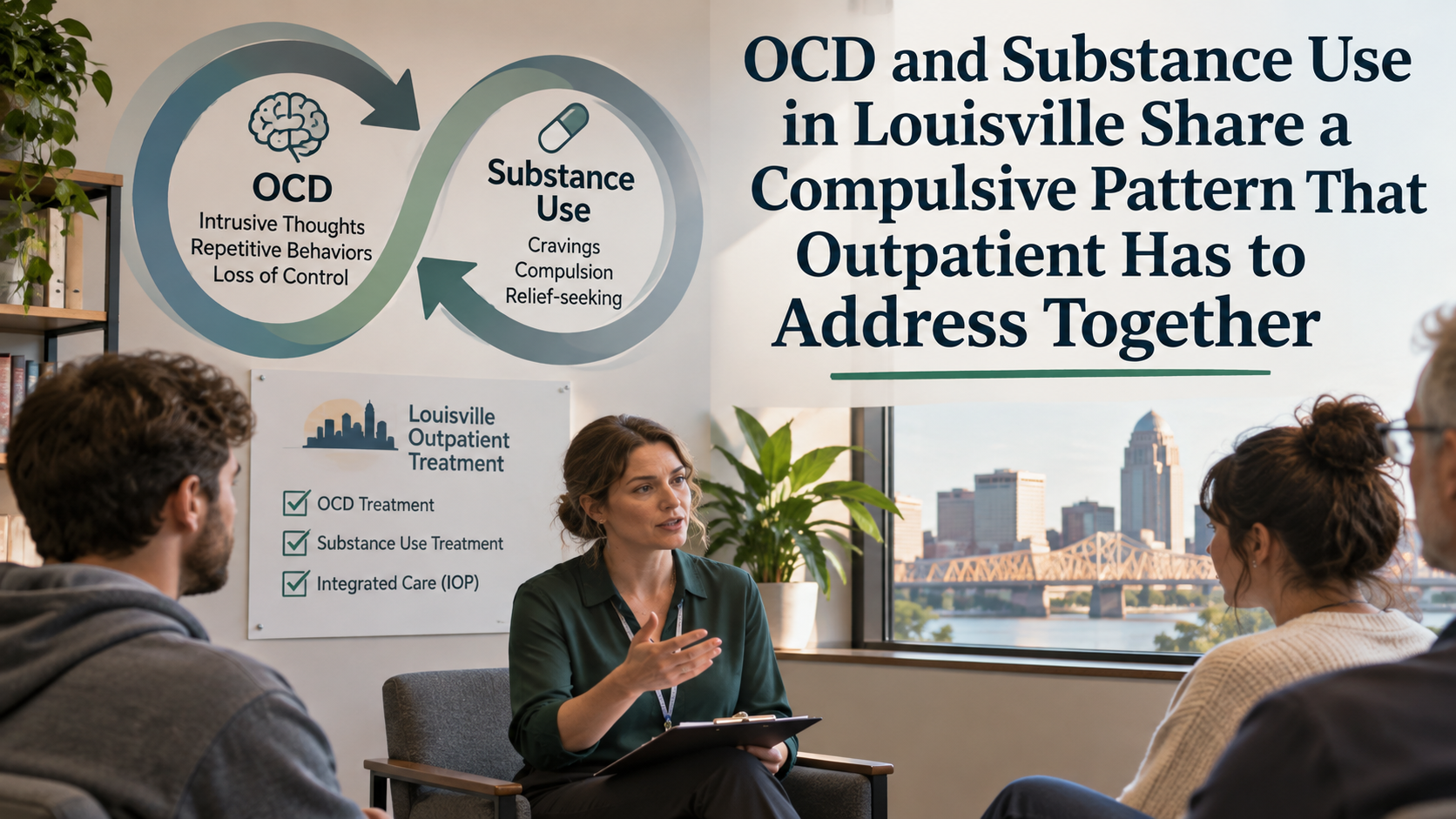
OCD and substance use in Louisville share a compulsive pattern because both follow the same cycle. Discomfort builds, an action brings relief and that relief teaches the brain to repeat the action.
In OCD, the action is a ritual. In addiction, the action is drinking or using.
Over time, the two loops can blend together. It can become hard to tell where one ends and the other begins.
How Can Substance Use Become Another Compulsion?
Substance use can become another compulsion when a person drinks or uses mainly to escape intrusive thoughts or to stop the urge to perform rituals. The substance works like a ritual and offers a few hours of quiet.
Some people use alcohol or cannabis to sleep when their mind will not stop. Others take sedatives that were not prescribed to dull the anxiety that comes with obsessions.
For many people living with OCD and substance use in Louisville, this starts as a reasonable attempt to cope. Only later does it become its own struggle.
Why Does Relief Make Both Patterns Stronger?
Relief makes both patterns stronger because the brain learns that escape is the only way to feel okay. Each time a ritual or a substance eases distress, the urge to repeat it grows.
As alcohol or drugs wear off, anxiety often rebounds. Withdrawal can also make intrusive thoughts feel louder, which sets up the next ritual and the next drink.
Day to day, the cycle often looks like this:
- An intrusive thought sparks fear, guilt or doubt.
- A ritual or substance quiets the feeling for a short time.
- The relief fades, and anxiety returns stronger.
- Sleep and mood suffer, which makes it harder to cope.
- The urge to ritualize or use grows simply to feel steady again.
Seeing yourself in this cycle is not a reason for shame. It points toward care for OCD and substance use in Louisville that addresses both loops at once.
Why Does Treating Only One Condition Fall Short?
Treating only one condition falls short because the untreated loop keeps pulling the treated one backward. Progress in one area rarely holds while the other stays active.
Separate care often means two intakes, two plans and providers who may never compare notes. For people managing OCD and substance use in Louisville, important warning signs can slip through that gap.
What Happens When Only the Substance Use Is Treated?
When only the substance use is treated, OCD symptoms often grow louder in early sobriety because nothing is muffling them anymore. Obsessions that alcohol once dulled can suddenly feel overwhelming.
Without tools to manage those thoughts, the old coping habit can feel like the only option. That is not a lack of willpower. It is the predictable result of leaving half the picture untreated.
What Happens When Only OCD Is Treated?
When only OCD is treated, ongoing substance use makes the most effective OCD therapy much harder to complete. That therapy works by helping you sit with anxiety until it fades on its own.
If a substance numbs that anxiety, the brain never gets the chance to learn that it can handle the feeling. Hangovers and withdrawal also make it hard to attend sessions and practice skills between them.
Some medications call for careful thought too. Benzodiazepines can ease anxiety in the short term but carry a risk of dependence, so a team experienced with OCD and substance use in Louisville weighs those choices carefully.
What Does Integrated Outpatient Care for OCD and Substance Use in Louisville Look Like?
Integrated outpatient care for OCD and substance use in Louisville means one coordinated team treats both conditions at the same time, within one shared plan, while you live at home. Nothing important gets lost between separate offices.
Care usually begins with a thorough assessment of your obsessions, rituals, substance use, physical health and daily stressors. That picture shapes a plan built around your real life rather than a generic template.
At Louisville Addiction Treatment Center, integrated dual diagnosis care brings mental health and addiction treatment together. Your providers share one view of how your OCD symptoms and substance use connect.
Which Therapies Help Treat Both Together?
The therapies that help most with OCD and substance use in Louisville teach you to face distress without escaping into rituals or substances. A personalized plan may include:
- Exposure and response prevention (ERP), a form of cognitive behavioral therapy (CBT), helps you face feared thoughts in small, planned steps while resisting the urge to ritualize.
- CBT for substance use helps you spot the thoughts and triggers that lead toward drinking or using.
- Dialectical behavior therapy (DBT) skills teach you to ride out intense urges without acting on them.
- Medication management with a psychiatric provider may include options commonly used for OCD, such as certain antidepressants, with every decision made together with you.
- Medication-assisted treatment (MAT) may help with opioid or alcohol use disorders when appropriate.
- Family sessions help loved ones step back from constant reassurance, which can quietly feed OCD.
These skills strengthen each other. Learning to tolerate the urge to check builds the same strength you use to tolerate a craving.
Which Outpatient Levels of Care Are Available?
Outpatient care includes three main levels, each matched to a different stage of recovery:
- Partial hospitalization program (PHP) offers several hours of treatment most days of the week, with evenings at home.
- Intensive outpatient program (IOP) provides at least 9 hours of therapy each week, often with evening options around work, school or family.
- Standard outpatient care involves one or two sessions a week as your skills become more reliable.
Many people step up or down as their needs change. A caring team can help you choose among flexible outpatient programs without switching providers. If withdrawal from alcohol or benzodiazepines could be dangerous, medically supervised detox may need to come first.
How Do You Know It Is Time to Seek Integrated Care?
You may be ready for integrated care if obsessions, rituals and substance use keep shaping each other in ways you cannot untangle alone. You do not need a formal diagnosis to start the conversation.
Consider these signs:
- You drink or use to quiet intrusive thoughts or to stop the urge to perform rituals.
- Your obsessions feel louder on the days after you drink or use.
- You tried to cut back, and your OCD symptoms grew so strong that you started using again.
- Past treatment addressed only your OCD or only your substance use.
- Rituals, checking or reassurance-seeking take up more of your day than they used to.
- Someone close to you has gently shared concern about your well-being.
If even one of these feels familiar, an assessment for OCD and substance use in Louisville is a reasonable next step. If you are having thoughts of suicide, call or text 988, or call 911 if you are in immediate danger.
Common Questions Before Starting Treatment
Which condition gets treated first? Neither. Both are treated together, because calmer OCD symptoms support steadier sobriety and steadier sobriety makes OCD therapy more effective.
Will my OCD get worse when I stop drinking or using? It can for a while, especially during withdrawal. Integrated care for OCD and substance use in Louisville prepares you with coping skills, close monitoring and extra support when you need it.
Is ERP too intense during early recovery? ERP moves at a pace you can manage. Your team starts with small steps and builds gradually as your stability grows.
Can I keep working during treatment? Yes, in many cases. Evening IOP tracks and standard outpatient sessions are designed to fit around work, school and family.
Take the Next Step Toward Breaking the Cycle
OCD and substance use in Louisville share a compulsive pattern, and outpatient care works best when it addresses both loops together. When one team understands how intrusive thoughts, rituals and substance use connect, you gain tools that make each day feel more manageable.
You deserve care that sees your whole story and honors your dignity. Recovery is possible, and you do not have to carry this alone.
If obsessions and substance use have been feeding each other, reach out to Louisville Addiction Treatment Center today. Our compassionate team can answer your questions, explain your options and help you build a path forward around your needs.