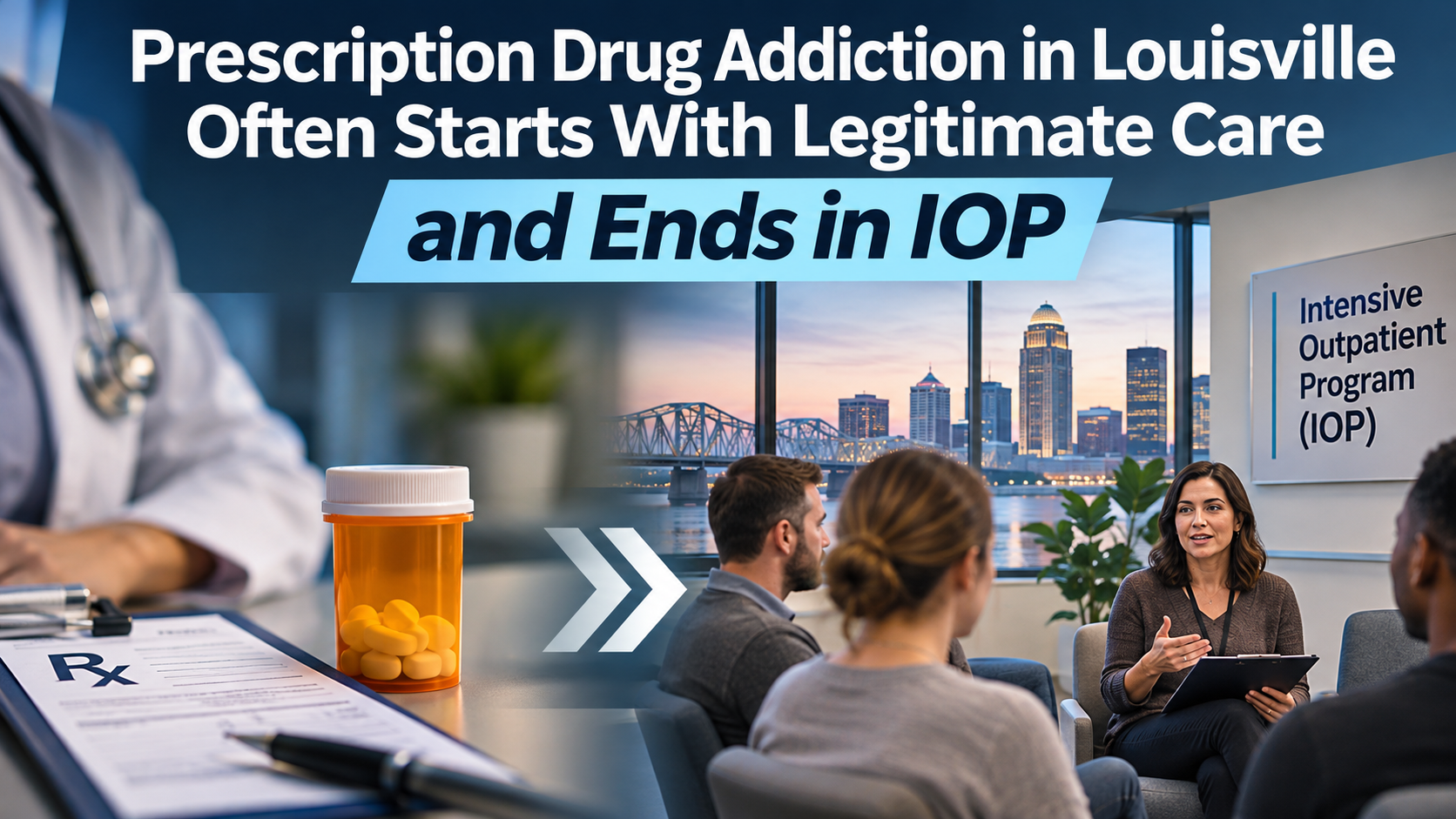
Prescription drug addiction in Louisville often begins in a doctor’s office, with a medication prescribed for a real and understandable reason. If you or someone you love started taking a pain reliever, an anxiety medication or a focus medication exactly as directed and now feels unable to stop, you are not alone.
Maybe it began after a surgery, a back injury or a season of panic attacks. The medication helped. It came from a provider you trusted, so there was little reason to question it.
Over time, the relief started to feel necessary. That shift can bring confusion, guilt and fear about what stopping might involve.
None of this means you did something wrong. It reflects how certain medications change the brain over time. Help is available, and the next step may be simpler than it feels right now.
What Is Prescription Drug Addiction in Louisville and How Does It Begin?
Prescription drug addiction in Louisville is a pattern of continued medication use that causes harm, and it often begins with a legitimate prescription for pain, anxiety, sleep or attention. Clinicians call it a substance use disorder when use continues despite its effects on health, work or relationships.
Three medication classes account for most cases:
- Opioids such as oxycodone and hydrocodone, often prescribed for pain after surgery or injury
- Benzodiazepines such as alprazolam (Xanax) and clonazepam (Klonopin), often prescribed for anxiety, panic or sleep
- Stimulants such as amphetamine salts (Adderall) and methylphenidate (Ritalin), often prescribed for attention-deficit/hyperactivity disorder (ADHD)
Each of these medications has real medical value. Each also affects the brain’s reward and stress systems, which is why prescription drug addiction in Louisville can develop even with careful use.
How Does Each Medication Class Lead to Dependence?
Each medication class leads to dependence by changing a different brain system, and the brain gradually adjusts to that change. The adjustment is biological, not a matter of character.
Opioids attach to receptors that ease pain and release dopamine, a brain chemical tied to reward. With steady use, the brain turns down its own signals, so more medication is needed for the same relief.
Benzodiazepines boost the brain’s main calming chemical, gamma-aminobutyric acid (GABA). The brain compensates by quieting its own calming system, which is why stopping suddenly can be medically dangerous.
Stimulants raise dopamine and norepinephrine to sharpen focus. Taken in higher doses than prescribed, they can create a cycle of bursts of energy followed by exhausting crashes.
Why Does the Shift From Patient to Person With a Substance Use Disorder Happen So Gradually?
The shift happens gradually because tolerance, dependence and changing reasons for use build in small steps that each feel reasonable at the time. Most people cannot point to a single moment when things changed.
The progression often looks like this:
- A medication is prescribed and helps as intended.
- The same dose starts working less well, so a person takes a little extra.
- Missing a dose brings discomfort that feels like the original problem returning.
- The medication becomes a way to manage stress or emotions, not just symptoms.
- Refills run out early, and worry about running out grows.
Because every step starts with a prescription, prescription drug addiction in Louisville can hide in plain sight. Family members may not see it, and the person taking the medication may not either.
What Is the Difference Between Dependence and Addiction?
Dependence means the body has adapted to a medication and reacts when the dose is reduced. Addiction means use continues despite harm and feels hard to control.
Many people taking long-term medication develop dependence without addiction. When control slips and use starts causing harm, prescription drug addiction in Louisville has reached the point where clinical care can make a real difference.
Why Does Shame Keep People Quiet?
Shame keeps people quiet because they believe misusing a prescribed medication reveals a flaw in who they are. That belief is understandable, and it is also inaccurate.
These medications are prescribed precisely because they are powerful. Seeing prescription drug addiction in Louisville as a health condition makes it easier to ask for help early.
What Are the Warning Signs of Prescription Drug Addiction in Louisville?
The warning signs of prescription drug addiction in Louisville include taking more than prescribed, running out of refills early and feeling unwell without the medication. You may notice some of these in yourself or a loved one:
- Taking higher or more frequent doses than directed
- Running out of a prescription before the expected refill date
- Seeing more than one provider for the same type of medication
- Feeling anxious, achy or exhausted when a dose is late
- Using the medication to cope with stress, sadness or boredom
- Continuing to use after the original pain or problem has improved
- Feeling defensive or secretive about medication use
Kentucky tracks controlled prescriptions through the Kentucky All Schedule Prescription Electronic Reporting (KASPER) system. For some people, a conversation about refill patterns with a prescriber is the first moment these signs come to light.
Please do not stop opioids or benzodiazepines suddenly on your own. Benzodiazepine withdrawal can cause seizures, and opioid tolerance drops quickly, which raises overdose risk if use resumes. Pills obtained outside a pharmacy may also contain fentanyl, so keeping naloxone (a medication that can reverse an opioid overdose) nearby is a simple safety step.
Why Is IOP Often the Right Level of Care for Prescription Drug Addiction in Louisville?
An intensive outpatient program (IOP) is often the right level of care because it provides frequent clinical support while you keep working, parenting and living at home. Many people facing prescription drug addiction in Louisville still hold jobs and family roles that a residential stay would interrupt.
The American Society of Addiction Medicine (ASAM) describes adult IOP as at least 9 hours of structured treatment each week. That time includes group therapy, individual counseling and skill-building, often with evening options.
What Does IOP Include?
IOP includes evidence-based therapy, medical oversight and relapse prevention, all coordinated by one team. A personalized plan may include:
- Cognitive behavioral therapy (CBT) to spot the thoughts and triggers that lead to misuse
- Medically guided tapering for benzodiazepines or opioids, adjusted to how your body responds
- Medication-assisted treatment (MAT) such as buprenorphine or naltrexone for opioid use disorder, when appropriate
- Group therapy with peers whose use also began with a prescription
- Family sessions that help loved ones support recovery without judgment
- Relapse prevention planning for pain flare-ups, stressful weeks and pharmacy visits
How Is the Original Pain or Anxiety Still Managed?
The original pain or anxiety is still managed through non-addictive medications, physical therapy referrals and practical coping skills. The condition that led to the prescription still matters.
Good care for prescription drug addiction in Louisville never ignores it. With your permission, your team can coordinate with your prescribing doctor so everyone works from one plan.
How Does Integrated Dual Diagnosis Care Fit In?
Integrated dual diagnosis care treats the medication misuse and the condition behind the prescription at the same time. Someone prescribed benzodiazepines for panic still needs care for panic, and someone prescribed stimulants for ADHD still needs support for focus.
When only the misuse is treated, the original symptoms often return and pull recovery backward. At Louisville Addiction Treatment Center, integrated dual diagnosis care brings psychiatric support and addiction treatment into one coordinated plan.
This matters for prescription drug addiction in Louisville because depression, anxiety, chronic pain and trauma are so often part of the story. One team that sees the whole picture can respond before small struggles grow.
Which Outpatient Levels of Care Are Available?
Outpatient care for prescription drug addiction in Louisville includes three levels, each matched to a different stage of recovery:
- Partial hospitalization program (PHP) offers several hours of treatment most days of the week, with evenings at home.
- Intensive outpatient program (IOP) provides at least 9 hours of therapy each week around work, school or family.
- Standard outpatient care involves one or two sessions a week as stability grows.
Many people step up or down as their needs change. A caring team can help you choose among flexible outpatient programs without switching providers. If withdrawal could be dangerous, medically supervised detox may come first.
How Do You Know It Is Time to Seek Help?
You may be ready to seek help if a prescribed medication has started to feel harder to control than it once did. You do not need to wait for a crisis.
Consider these signs as you weigh your next step:
- You take more of your medication than prescribed, or you take it more often.
- You feel sick, anxious or restless when a dose is late.
- You have tried to cut back and found it harder than you expected.
- You use the medication to cope with emotions rather than the original symptoms.
- Your refills run out early, and you worry about running out.
- Someone close to you has gently shared concern about your medication use.
If even one of these feels familiar, an assessment for prescription drug addiction in Louisville is a reasonable next step. If you are having thoughts of suicide, call or text 988, or call 911 if you are in immediate danger.
Common Questions Before Starting Treatment
Can I become addicted even if I followed my prescription? Yes. Dependence can develop with regular use, and addiction can follow as the brain adapts. This is a biological response, not a sign of weak character.
Will I have to stop my medication right away? No. Benzodiazepines and opioids are usually reduced gradually under medical supervision. Your team adjusts the pace to keep you safe and as comfortable as possible.
Can I keep working during IOP? Yes, in many cases. Many people receive care for prescription drug addiction in Louisville through evening IOP tracks that fit around work and family.
Will my doctor or employer find out? Treatment is confidential, and federal privacy laws protect your health information. Your team will only coordinate with your prescriber if you give permission.
Take the Next Step Toward Steady Recovery
Prescription drug addiction in Louisville often starts with legitimate care, and that beginning deserves understanding rather than blame. With IOP, integrated dual diagnosis care and a plan built around your needs, many people find steadier ground.
You deserve care that respects how this started and treats both the medication use and the reason behind it. Recovery is possible, and you do not have to walk this path alone.
If a prescription has become harder to manage, reach out to Louisville Addiction Treatment Center today. Our compassionate team can answer your questions confidentially, explain your options and help you take the next step with confidence.