
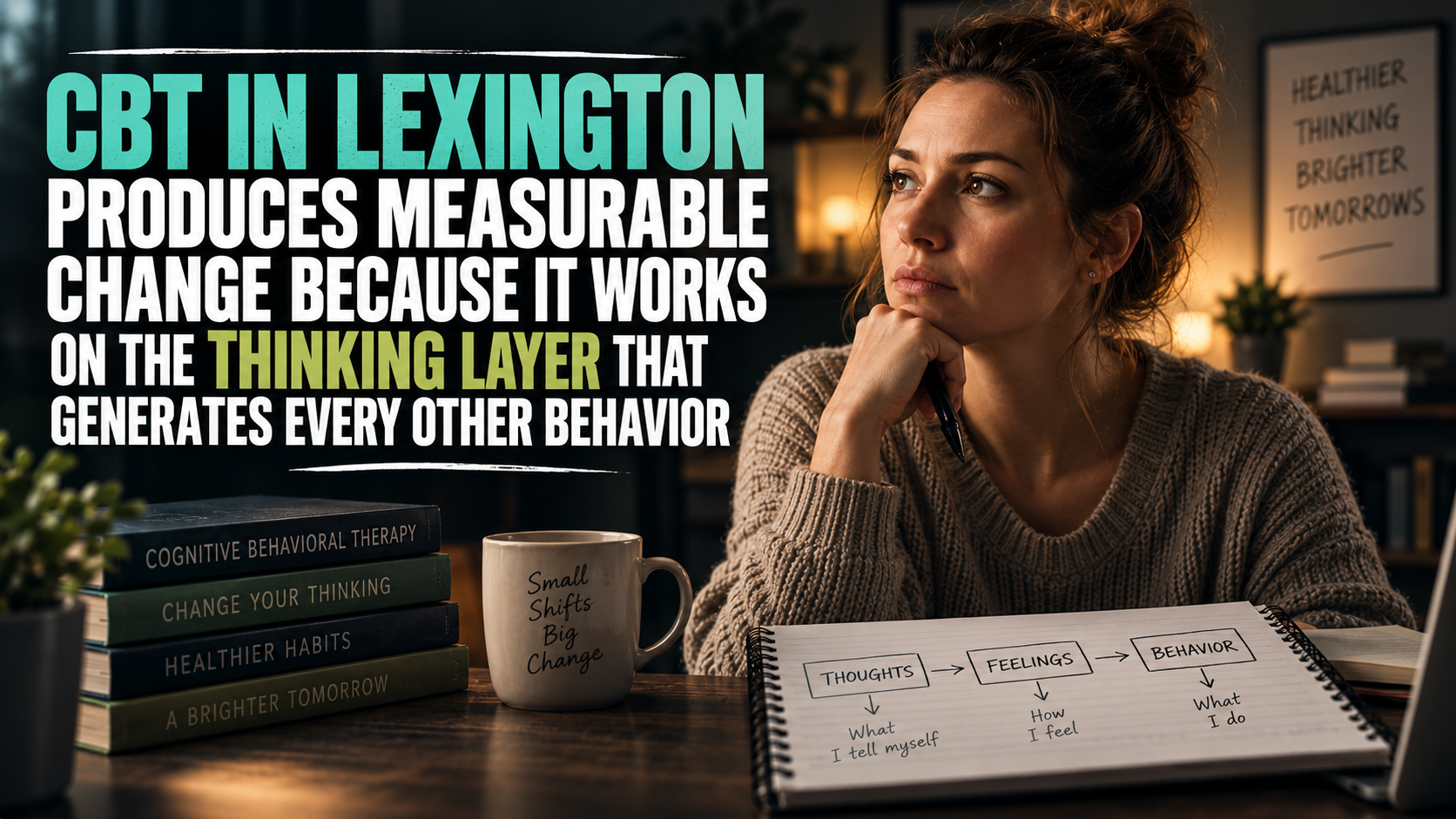
CBT in Lexington helps people create real, measurable change because it targets the thoughts that shape every feeling and action that follows. If you or someone you love has tried to change a behavior through sheer effort and watched it slip back, that experience makes sense.
You may have promised yourself things would be different, only to find the same patterns returning. That does not mean you failed, and it does not mean change is out of reach.
The trouble is that behavior often starts one layer deeper, in the way we think. When you change the thoughts that drive a reaction, the behavior tends to shift with them. Understanding how this works can replace frustration with clarity, and support is closer than it may feel right now.
What Is CBT in Lexington and How Does It Work?
CBT in Lexington is a structured, evidence-based form of therapy that helps you recognize and reshape the thoughts that drive your feelings and behaviors. The full name is cognitive behavioral therapy, and it is one of the most researched approaches in mental health care.
The core idea is simple to grasp. What you think shapes how you feel, and how you feel shapes what you do. Those three pieces constantly loop together.
CBT does not ask you to pretend a painful thought is untrue. Instead, it teaches you to examine that thought, test whether it holds up, and respond in a way that fits reality more closely.
This work is active, not passive. You and your therapist set goals, practice skills, and track your progress across a series of focused sessions.
Why Does CBT Work on the Thinking Layer First?
CBT works on the thinking layer first because thoughts sit upstream of nearly every feeling and behavior that follows. Change the thought, and the reaction it creates often begins to change too.
Picture a single event, like a stressful phone call. The event itself does not decide how you respond. The thought you have about it does.
If you think “I cannot handle this,” anxiety rises and you may reach for an old coping habit. If you think “This is hard, and I can get through it,” the same event feels far more manageable.
How Do Thoughts Drive Behavior?
Thoughts drive behavior by shaping the emotions that push us to act. A thought sparks a feeling, and that feeling often leads directly to a choice.
Many of these thoughts happen automatically, so fast you barely notice them. They can feel like facts even when they are really assumptions.
CBT slows that process down. When you learn to catch a thought before it turns into a reaction, you gain a moment of choice that was not there before.
Why Is Willpower Alone Not Enough?
Willpower alone is often not enough because it tries to change the behavior while leaving the thought untouched. You can force a different action for a while, but the underlying belief keeps pulling you back.
This is why lasting change rarely comes from effort alone. When the thought stays the same, the pressure to return to the old behavior stays too.
CBT eases that pressure by working where the pattern begins. You are not fighting yourself, you are updating the thinking that made the struggle feel so hard.
How Does CBT Produce Measurable Change?
CBT produces measurable change by setting clear goals and tracking real progress over time. This is not vague self-reflection. It is a focused process with steps you can see and feel.
From the start, you and your therapist name what you want to change. That might mean fewer panic episodes, better sleep, or steadier days without turning to substances.
Along the way, you use practical tools that create visible results. Progress becomes something you can point to, not just something you hope for.
What Tools Make Change Trackable?
The tools that make change trackable include thought records, behavioral experiments, and coping skills you practice between sessions. Each one turns insight into action you can measure.
- Thought records help you slow down a distressing thought and examine the evidence for and against it.
- Behavioral experiments let you test an anxious prediction in real life and see what actually happens.
- Coping skills like grounding and breathing give you concrete ways to steady yourself in hard moments.
- Goal tracking helps you and your therapist notice progress and adjust the plan as you grow.
These tools reinforce each other. Together, they help you see change unfold step by step rather than all at once.
Who Benefits From CBT in Lexington?
CBT in Lexington can benefit people facing anxiety, depression, trauma, substance use, and many other struggles where unhelpful patterns take hold. Its structured design makes it adaptable to a wide range of needs.
You do not need a severe diagnosis to benefit. Many people use these skills to manage everyday stress, self-doubt, or difficult transitions.
CBT may be a good fit if any of these feel familiar for you or a loved one:
- You get caught in cycles of worry that feel impossible to switch off.
- Negative thoughts about yourself feel automatic and hard to question.
- You avoid situations because they trigger fear or discomfort.
- Low mood keeps you from activities that once brought meaning.
- You use substances to quiet anxious or painful thoughts.
Recognizing yourself in one of these is not a weakness. It is a sign that a structured, skill-based approach could help you feel steadier.
What Is the Link Between CBT and Substance Use Recovery?
The link between CBT and substance use recovery is strong, because it helps people identify the thoughts and triggers that drive the urge to use. Substance use often follows a predictable emotional pattern, and cognitive behavioral therapy helps interrupt it.
Many people reach for substances to escape anxiety, shame, or painful memories. CBT helps you recognize those triggers before they take over.
Once you can spot the pattern, you can practice healthier responses. That might mean using a coping skill, reaching out to someone, or challenging the thought that led toward using.
How Does CBT Support Dual Diagnosis Care?
CBT supports dual diagnosis care by treating the thought patterns that connect a mental health condition and substance use. When both occur together, addressing them as one story tends to work better than treating either alone.
Anxiety, depression, or trauma often fuel the urge to use, and substances often deepen those same struggles. CBT helps you see and break that loop.
When conditions overlap, integrated dual diagnosis care weaves CBT into a larger plan that supports lasting recovery. This coordinated approach addresses the whole person, not a single symptom.
What Flexible Outpatient Options Are Available?
Flexible outpatient options let you build CBT skills while continuing to work, study, and care for your family. You do not have to step away from your entire life to get help.
Outpatient care offers real clinical structure without a residential stay. You attend scheduled sessions, then practice new skills in the environment where you actually live.
The levels of care range from more intensive daytime support to lighter weekly sessions, each matched to a different stage of recovery:
- Partial hospitalization offers structured treatment during the day while you return home in the evenings.
- Intensive outpatient care provides several therapy sessions each week, balancing strong support with flexibility.
- Standard outpatient care involves fewer weekly sessions as you build independence.
Many people move through these levels gradually, stepping down as they gain stability. A caring team can help you find flexible outpatient support that fits your needs and your schedule.
How Do You Know CBT Might Be Right for You?
You may find CBT is a good fit if you want practical tools and a clear plan rather than open-ended conversation alone. You do not need to wait until things feel unbearable to explore it.
Consider reaching out to a professional if any of these feel true for you or a loved one:
- You want concrete skills you can practice, not just talk about your feelings.
- Anxious or negative thoughts keep interfering with your daily life.
- You have tried to change a behavior through effort alone and it did not last.
- You are avoiding situations, people, or responsibilities out of fear.
- You are managing both mental health and substance use concerns at once.
If even one of these resonates, that is reason enough to talk with a professional. Choosing structured support is not a sign of failure. It is a practical step toward feeling more in control.
Common Questions Before Starting Treatment
How long does CBT usually take? CBT is often shorter than open-ended therapy, with many people attending a focused series of sessions. The exact length depends on your goals, and your therapist will help you set a realistic plan.
Is CBT just about controlling my thoughts? No. CBT addresses thoughts, feelings, and behaviors together. It gives you tools to respond to distress in healthier ways, not to suppress every thought.
Will I have to do homework between sessions? Yes, and that practice is part of what makes it effective. Homework is usually simple and practical, like completing a thought record or trying a small behavioral experiment.
Can CBT help with both anxiety and substance use? Yes. CBT is widely used for both, and it works especially well when they overlap. Integrated care can address both concerns within one coordinated plan.
Take the Next Step Toward Measurable Change
CBT in Lexington produces measurable change because it works on the thinking layer that shapes every feeling and behavior that follows. When you update the thoughts driving a pattern, real and lasting change becomes far more possible.
You deserve support that respects your intelligence, honors your pace, and gives you practical skills you can rely on. Choosing structured care is not a weakness. It is the beginning of meaningful progress.
If you have been searching for more than surface-level advice, help is available whenever you are ready. Reach out to Impact IOP today to learn how our compassionate team can support you or your loved one with clear, personalized care and a path forward built around your needs.