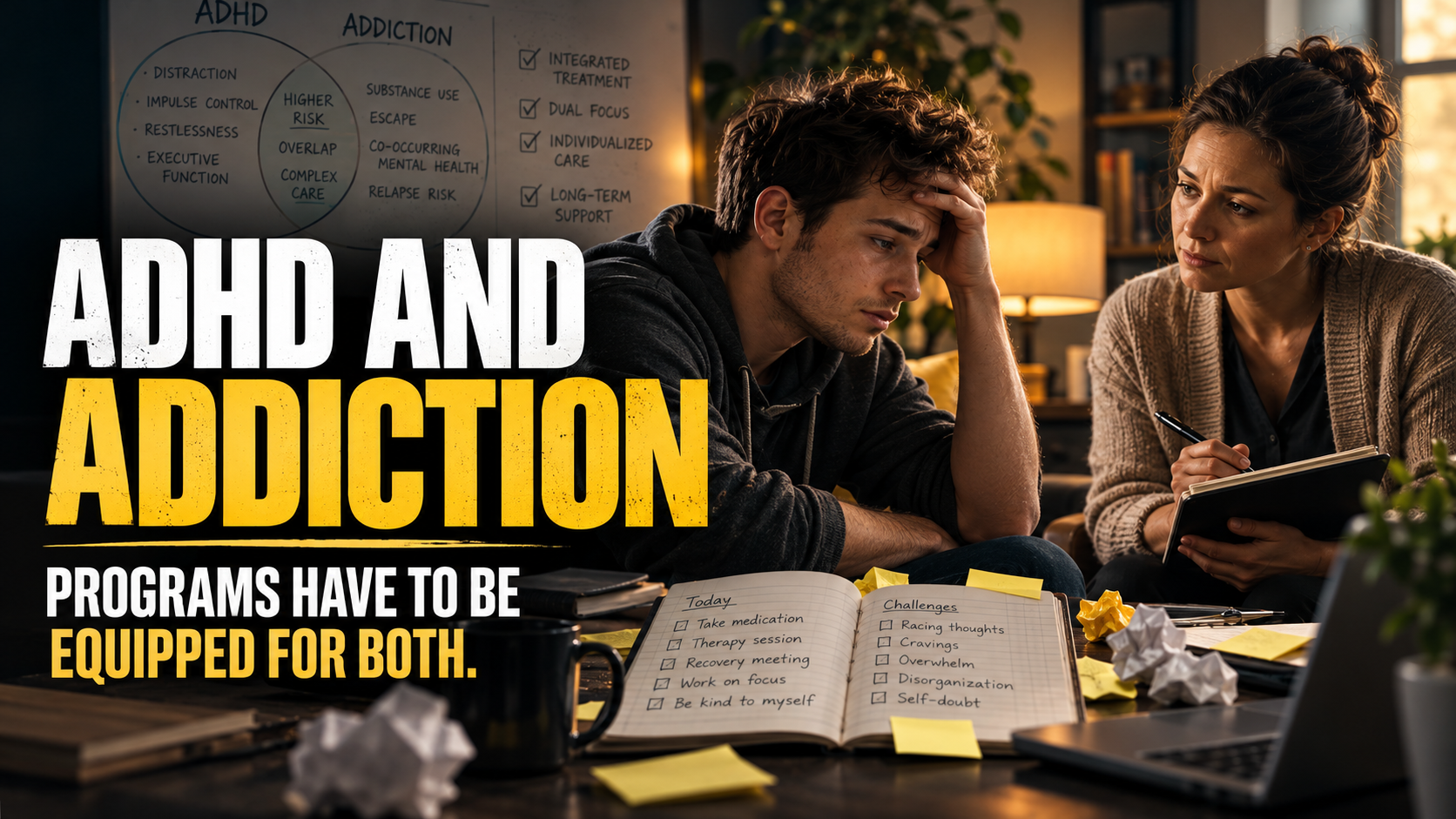
ADHD and addiction often show up together, and when attention-deficit/hyperactivity disorder (ADHD) goes unrecognized, substance use can quietly step in to fill the gap. If you or someone you love has struggled with focus, restlessness or impulsivity alongside alcohol or drug use, you may have wondered how the two connect.
Maybe school or work always felt harder for you than it seemed for everyone else. Maybe a drink finally quieted a racing mind, or a stimulant made it possible to finish a task. Over time, what began as coping can become its own struggle.
None of this means you lack willpower or character. It means two real health conditions may be affecting each other, and care that sees only one can leave the other behind. Understanding how ADHD and addiction interact is a hopeful first step, and support is closer than it may feel right now.
What Do ADHD and Addiction Look Like Together?
ADHD and addiction together often look like a cycle of restlessness, impulsive choices and substance use that eases symptoms for a short time before making daily life harder. ADHD is a neurodevelopmental condition that affects attention, activity level and impulse control. Addiction, also called substance use disorder, involves continued use despite harm.
Each person’s experience is different. Some people notice trouble focusing first. Others notice the substance use first and only later recognize the attention challenges that were there all along.
What Signs Might You Notice?
The signs often blend attention challenges with patterns of use. You may recognize some of these in yourself or a loved one:
- Trouble finishing tasks, following through or staying organized
- Acting on impulse, including using substances without planning to
- Feeling restless or bored unless something feels intense or new
- Using alcohol or cannabis to calm a busy mind or fall asleep
- Using stimulants that were not prescribed to focus or stay productive
- Missing deadlines, appointments or responsibilities more often over time
Seeing yourself here is not a reason for shame. It is useful information that can point toward the right kind of care.
Why Do ADHD and Addiction Co-Occur So Frequently?
ADHD and addiction co-occur frequently because they share overlapping brain pathways, and because many people with untreated ADHD turn to substances to manage their symptoms. Research has consistently found that people with ADHD are more likely to develop a substance use disorder than people without it.
This connection is well recognized by clinicians. It does not mean everyone with ADHD will develop an addiction. It means the risk deserves attention.
How Does the Brain’s Reward System Play a Role?
The brain’s reward system plays a role because ADHD is linked to differences in how the brain uses dopamine, a chemical messenger tied to motivation and focus. Many substances cause a surge of dopamine, which can feel like relief to a brain that struggles to stay engaged.
That relief is temporary. With repeated use, the brain adapts, and the substance can start to feel necessary just to function.
Why Does Self-Medication Happen?
Self-medication happens because people naturally reach for whatever eases symptoms they cannot explain. Without a diagnosis, alcohol, cannabis or stimulants can seem like the only tools available.
Impulsivity can also make it harder to pause before using. That is a symptom of a health condition, not a moral failing.
How Can Each Condition Mask or Mimic the Other?
Each condition can mask or mimic the other because substance use, withdrawal and ADHD can all produce poor focus, irritability, restlessness and trouble sleeping. This overlap is one reason ADHD and addiction are so often misread.
How Can Substance Use Look Like ADHD?
Substance use can look like ADHD when intoxication, hangovers or withdrawal cause scattered thinking and restlessness. Heavy cannabis use can dull memory and motivation, and stimulant withdrawal can bring exhaustion and poor concentration.
Clinicians often need time to observe attention patterns once substance use slows or stops. A careful history that reaches back to childhood also helps, since ADHD symptoms typically begin early in life. This is why an accurate picture of ADHD and addiction takes patience.
How Can ADHD Hide Behind Substance Use?
ADHD can hide behind substance use when a treatment team sees the drinking or drug use and assumes it explains everything. Lifelong attention challenges may be labeled as effects of addiction and never treated directly.
Many adults also reach adulthood without a diagnosis, especially when their symptoms looked like quiet inattention rather than hyperactivity. Women and girls are often overlooked for this reason.
Why Do Programs Not Equipped for Both Consistently Undertreat One?
Programs not equipped for both conditions consistently undertreat one because their staff, assessments and treatment tools are built for a single focus. When a program only screens for substance use or only treats mental health, the other condition can go unnoticed or be set aside for later.
This gap is rarely anyone’s fault. It reflects how care has often been divided into separate systems. Still, for people living with ADHD and addiction, that division can turn recovery into a frustrating loop.
What Happens When Only Addiction Is Treated?
When only addiction is treated, ADHD symptoms often return to the surface once substances are gone. Restlessness, distraction and impulsivity can make it hard to attend sessions, complete assignments or follow a relapse prevention plan.
Without tools for those symptoms, the old way of coping can feel like the only option. This is one common reason recovery stalls.
What Happens When Only ADHD Is Treated?
When only ADHD is treated, ongoing substance use keeps disrupting focus, sleep and mood. Some programs also hesitate to address ADHD at all because of concerns about stimulant medication.
Those concerns are valid, but avoiding treatment altogether leaves real symptoms unmanaged. A team experienced with ADHD and addiction can weigh options carefully and safely.
What Does Integrated Dual Diagnosis Care for ADHD and Addiction Look Like?
Integrated dual diagnosis care treats ADHD and addiction at the same time, within one coordinated plan and one care team. Instead of moving between separate providers who rarely compare notes, you work with clinicians who see how both conditions connect.
Care usually begins with a thorough assessment of attention history, substance use, mental health and daily life. At Louisville Addiction Treatment Center, integrated dual diagnosis care uses that full picture to build a plan around you rather than a generic template.
A personalized plan may include:
- Psychiatric evaluation to clarify symptoms and check for related conditions like anxiety or depression.
- Cognitive behavioral therapy (CBT) to reshape thoughts that lead to impulsive use and build practical coping skills.
- Executive function support to strengthen planning, organization and time management.
- Relapse prevention planning that accounts for boredom, impulsivity and other ADHD-related triggers.
- Family education so loved ones understand both conditions and respond with patience.
Practical tools matter here. Reminders, written schedules and clear session structure can make treatment easier to follow and easier to stick with.
How Are Medication Decisions Handled?
Medication decisions are handled carefully and always made together with you. Some people benefit from non-stimulant ADHD medications, while others may use long-acting stimulant formulations with close monitoring.
Your provider will consider your substance use history, current stability and personal preferences. Medication-assisted treatment (MAT) for opioid or alcohol use disorders may also be part of care when appropriate.
What Flexible Outpatient Levels of Care Are Available?
Flexible outpatient levels of care for ADHD and addiction range from structured daily programming to lighter weekly sessions, each matched to a different stage of recovery. You receive real clinical support while living at home.
- Partial hospitalization program (PHP) offers several hours of treatment most days of the week, with evenings at home.
- Intensive outpatient program (IOP) provides multiple therapy sessions each week, often scheduled around work, school or family.
- Standard outpatient care involves fewer weekly sessions as stability and confidence grow.
Predictable routines support focus, which makes this kind of structure especially helpful. A caring team can help you choose among flexible outpatient programs and adjust your care as you progress.
If withdrawal could be dangerous or you are having thoughts of suicide, a higher level of care may be the safest place to start. Call or text 988, or call 911 if you are in immediate danger.
How Do You Know It Is Time to Seek Help?
You may be ready to seek help if attention challenges and substance use keep affecting each other in ways you cannot untangle alone. You do not need a confirmed diagnosis to start the conversation.
Consider these signs as you weigh your next step:
- You use alcohol or other substances to calm a racing mind, focus or sleep.
- You have taken stimulants that were not prescribed to keep up at work or school.
- Past treatment focused on substance use, but focus and impulsivity problems remained.
- You struggled with attention or restlessness long before substance use began.
- Impulsive decisions around using keep undoing your progress.
- Someone close to you has gently shared concern about your focus or your use.
If even one of these feels familiar, talking with a professional about ADHD and addiction is a reasonable next step. Reaching out is a sign of strength, not weakness.
Common Questions Before Starting Treatment
Can I be diagnosed with ADHD as an adult? Yes. Many people receive an ADHD diagnosis in adulthood. A careful evaluation looks at symptoms across your life, including childhood.
Is it safe to treat ADHD if I have a substance use disorder? Yes, with the right oversight. A team experienced in treating ADHD and addiction together can review non-stimulant options, closely monitored medication and skill-building approaches.
Which condition gets treated first? Both are treated together, not one after the other. Progress in one area tends to support progress in the other.
Can I keep working during treatment? Yes, in many cases. Intensive outpatient and standard outpatient programs are designed to fit around work, school and family schedules.
Take the Next Step Toward Balanced Recovery
ADHD and addiction present together often enough that care has to be ready for both. When a program treats attention challenges and substance use as connected parts of one story, you gain tools that make recovery feel more manageable.
You deserve care that sees the whole picture and honors your dignity. Recovery is possible, and you do not have to figure it out alone.
If focus, impulsivity and substance use have been feeding each other, reach out to Louisville Addiction Treatment Center today. Our compassionate team can answer your questions, explain your options and help you build a path forward around your needs.