
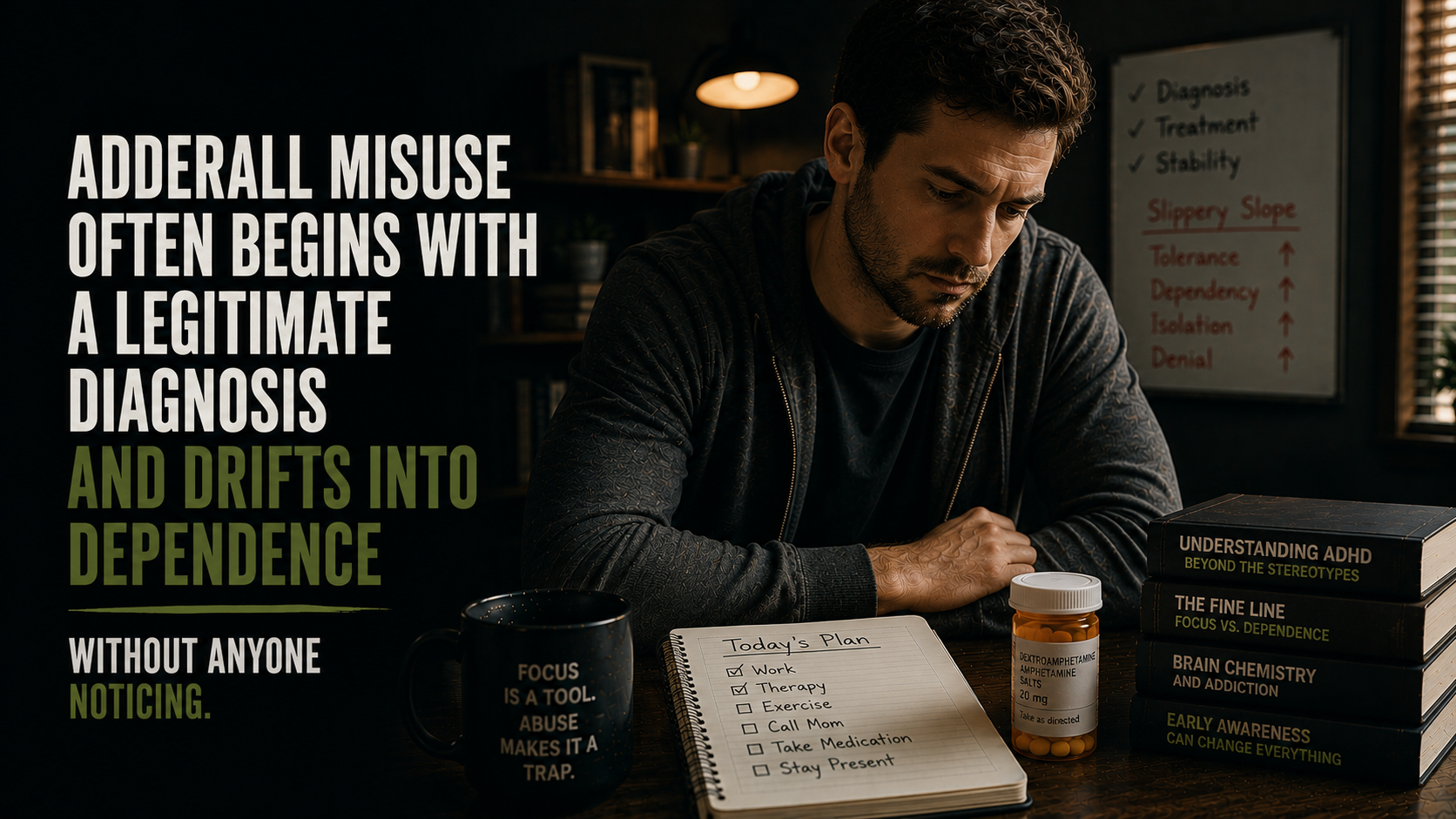
Adderall misuse often starts in the most unexpected place, a real diagnosis and a prescription written by a caring doctor. If you or someone you love has slowly come to rely on this medication in ways that feel hard to control, that experience is more common than you might think.
You may have taken it exactly as prescribed at first. Over time, though, the doses crept up, or you started using it to power through long days, quiet stress, or simply feel like yourself.
That drift can happen quietly, without any single moment where things clearly went wrong. It does not make you weak or careless. Adderall changes brain chemistry in ways that can turn ordinary use into dependence before anyone notices. Understanding how this happens can replace confusion with clarity, and support is closer than it may feel right now.
How Does Adderall Misuse Begin From a Legitimate Prescription?
Adderall misuse often begins when a person starts using a legitimate prescription in ways it was not intended, even without meaning to. It is a stimulant prescribed for attention-deficit hyperactivity disorder, and it works well for many people when taken as directed.
The trouble starts subtly. You might take an extra dose during a stressful week, use it to stay awake for a deadline, or lean on it to feel focused and productive.
None of these choices feel dramatic in the moment. Each one seems reasonable, especially when the medication came from a doctor and helped you before.
That is exactly why this pattern is so easy to miss. The source feels safe, so the shift toward misuse rarely raises alarm until it has already taken hold.
How Does Dependence Develop Without Anyone Noticing?
Dependence develops gradually because the brain adapts to Adderall over time, requiring more to achieve the same effect. This slow change often unfolds beneath everyday life, which is why it goes unseen for so long.
Adderall increases certain brain chemicals tied to focus, energy, and motivation. With regular use, the brain adjusts and begins to rely on the medication to feel balanced.
As that happens, the original dose may stop feeling like enough. Increasing the amount can seem like a practical fix rather than a warning sign.
Why Is the Slow Onset So Easy to Miss?
The slow onset is easy to miss because changes happen gradually enough to feel like part of normal life. A dose that once sharpened your focus may slowly become something you feel you cannot function without.
You might notice that skipping a dose leaves you foggy, drained, or irritable. It can be easy to blame that on a bad night’s sleep or a busy schedule rather than dependence.
Because the shift is so gentle, many people do not recognize it until they try to stop. That moment of difficulty is often the first real clue.
How Does a Legitimate Diagnosis Hide the Problem?
A legitimate diagnosis hides the problem because a prescription creates a sense of safety that masks growing dependence. When a trusted professional prescribes something, it feels categorically different from misuse.
That sense of safety is understandable, but it can delay recognition. You may hesitate to question a medication your doctor recommended, even when something feels off.
This is why so many people feel confused when dependence appears. There was no clear misuse to point to, only a prescription used in ways that quietly expanded over time.
What Are the Warning Signs of Adderall Misuse?
The warning signs of Adderall misuse show up in your body, your habits, and your relationship with the medication. Recognizing them early can open the door to supportive care.
You may notice some of these patterns in yourself or a loved one:
- You take higher doses than prescribed, or take it more often than directed.
- You feel unable to focus, work, or function without it.
- You use it to stay awake, manage stress, or boost your mood.
- You feel anxious, exhausted, or low when you go without a dose.
- You run out of your prescription earlier than expected.
- You hide how much you use or feel defensive when someone asks.
Noticing a few of these does not mean something is wrong with you. It means your body and mind may be signaling a need for support you have not yet received.
Why Is Adderall Misuse So Closely Linked to Mental Health?
Adderall misuse is closely linked to mental health because people often use it to manage underlying anxiety, depression, or stress. What feels like a productivity tool can quietly become a way to cope with deeper emotional struggles.
Stimulants can temporarily lift mood, sharpen focus, and mask fatigue. For someone facing anxiety or low energy, that relief can feel like exactly what they needed.
The relief never lasts. As the medication wears off, anxiety, irritability, and exhaustion often return, sometimes stronger than before.
How Does This Create a Difficult Cycle?
This creates a difficult cycle because each low pushes a person to reach for the medication again. You use it to feel steady, the effect fades, and the crash makes you want another dose.
Over time, this loop tightens. The medication starts to feel less like a choice and more like a necessity just to get through the day.
Breaking that cycle is not about willpower alone. When anxiety or depression drives the use, lasting recovery means treating both the misuse and the emotional pain beneath it. That is where integrated dual diagnosis care can make a real difference, addressing the whole picture rather than one piece of it.
How Does Integrated Outpatient Care Help With Adderall Misuse?
Integrated outpatient care helps by treating Adderall misuse and any co-occurring mental health conditions together, within one coordinated plan. Instead of focusing only on the medication, this approach looks at the whole person.
Care usually begins with a thorough assessment. This helps providers understand your history, symptoms, and goals so your plan fits you rather than a generic template.
From there, treatment blends therapy, skill-building, and support that fits around your daily life. You practice new tools in your real environment, which helps the progress hold over time.
What Therapies Support Recovery?
The therapies that support recovery help you understand your patterns and build healthier ways to cope. Several evidence-based approaches often work together.
- Cognitive behavioral therapy helps you notice and reshape the thoughts that fuel misuse and stress.
- Individual counseling gives you a private space to explore triggers and emotions at a safe pace.
- Group therapy connects you with others who understand, easing shame and isolation.
- Coping skill development helps you manage focus, stress, and energy without relying on the medication.
These pieces reinforce one another. Together, they treat the misuse and the underlying struggles as connected parts of one journey.
What Flexible Options Fit Around Daily Life?
Flexible outpatient options let you receive real clinical support while continuing to work, study, and care for your family. You do not have to step away from your entire life to get help.
The levels of care range from more intensive daytime support to lighter weekly sessions, each matched to a different stage of recovery. This flexibility lets treatment grow with you.
At Impact Outpatient Program®, flexible outpatient and intensive outpatient options help you find the level of support that fits your needs and your schedule.
How Do You Know It Is Time to Seek Support?
You may be ready to seek support if Adderall has started to feel less like a tool and more like something you cannot manage without. You do not need to reach a crisis point to take your experience seriously.
Consider reaching out if any of these feel true for you or a loved one:
- You take more than prescribed or use the medication in ways your doctor did not intend.
- You feel unable to focus, work, or cope without it.
- You use it to manage anxiety, stress, sadness, or low energy.
- You feel drained, irritable, or anxious when you go without a dose.
- You have tried to cut back but found it harder than expected.
- You are managing both Adderall misuse and a mental health condition.
If even one of these resonates, that is reason enough to talk with a professional. Reaching out is not a sign of failure. It is a caring, courageous step toward steadier ground.
Common Questions Before Starting Treatment
Can I become dependent on Adderall even if I have ADHD and a prescription? Yes. Dependence can develop over time, even when the medication treats a real diagnosis. Using it in higher doses or for reasons beyond its intended purpose can gradually lead to misuse, which is a health concern, not a personal failing.
Is it safe to stop taking Adderall on my own? It is best to make any changes with professional guidance. Stopping suddenly can bring fatigue, low mood, and difficulty concentrating, and a provider can help you reduce use safely while supporting your well-being.
What if I use Adderall to cope with anxiety or depression? Integrated treatment can address both the misuse and the mental health condition at the same time. Treating them together often works better than treating either one alone, because they frequently influence each other.
Can I get help without leaving work or school behind? Yes. Outpatient and intensive outpatient programs are built for flexibility, so support can fit alongside your daily responsibilities. You can receive meaningful care while staying connected to your life.
Take the Next Step Toward Steadier Ground
Adderall misuse often begins from a legitimate diagnosis and drifts into dependence so quietly that no one notices until it feels overwhelming. Understanding that truth can lift the weight of shame from you or someone you love, because this is a health concern, not a character flaw.
You deserve care that sees the whole picture, honors your dignity, and meets you exactly where you are. Recognizing that something has shifted is not a weakness. It is a wise and hopeful first step.
If Adderall has started to feel harder to manage than it once was, help is available whenever you are ready. Reach out to Impact Outpatient Program today to learn how our compassionate team can support you or your loved one with clear, personalized care and a path forward built around your needs.