
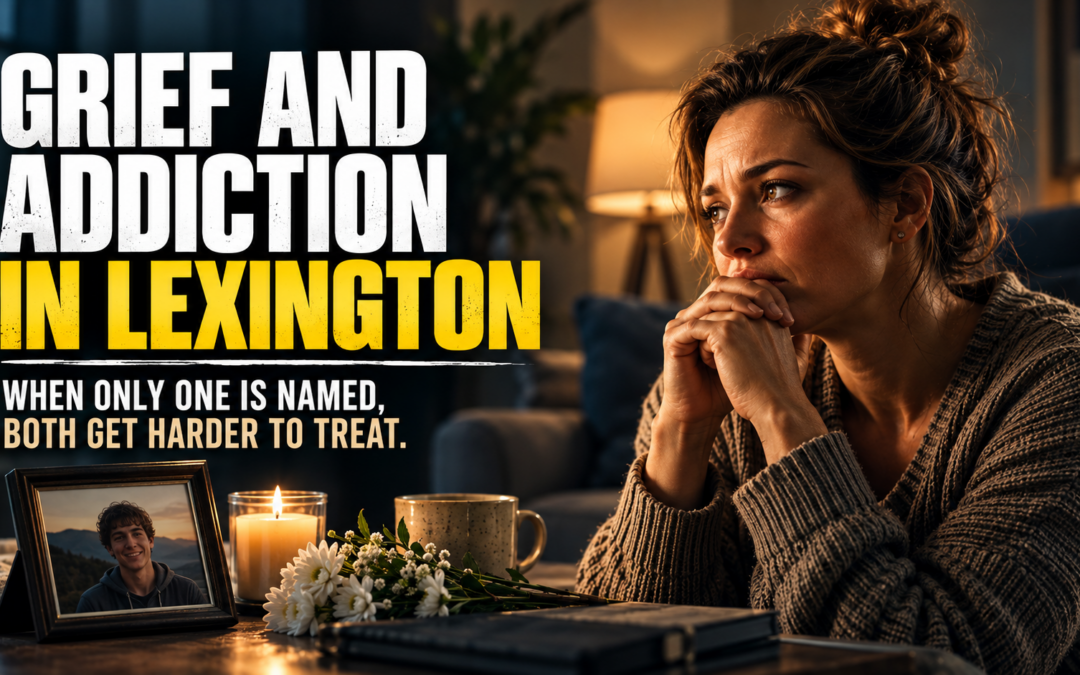
Grief and addiction in Lexington often show up together, yet many people only ever get help for one of them. If you have lost someone you love and found yourself drinking or using more to get through the days, you are not alone. You are not doing anything wrong.
Grief can feel like a weight that never lifts. Nights stretch on, and the quiet can feel unbearable. A drink or a pill may seem like the only thing that softens the ache, even for a few hours.
Families notice it too. You may see a parent, partner or adult child pulling away after a death and wonder whether you are seeing mourning or a substance problem. The honest answer is that it can be both.
When only one is named, the other keeps working in the background. Understanding how these two experiences connect can make the next step feel clearer. Support is available whenever you are ready.
What Happens When Grief and Addiction in Lexington Occur Together?
When grief and addiction in Lexington occur together, each one makes the other harder to heal. Loss creates deep emotional pain. Substances can become a way to numb it, and over time that coping turns into dependence.
Grief is a natural response to loss. It can follow the death of a loved one, a divorce, a job loss or the end of a way of life. It often brings sadness, guilt, anger, poor sleep and trouble focusing.
For most people, the sharpest pain softens over time. For some, grief stays intense and disruptive for a year or longer. Clinicians call this prolonged grief disorder. It is a recognized mental health condition, and it responds to treatment.
Substance use adds another layer. Alcohol and many drugs delay the natural work of grieving, so the loss stays raw instead of slowly finding its place.
Many families facing grief and addiction in Lexington are mourning someone they lost to an overdose. That kind of loss can carry extra guilt and stigma, which can make reaching out feel even harder.
Why Does Naming Only One Condition Keep the Cycle Going?
Naming only one condition keeps the cycle going because the untreated condition continues to drive the other. Grief and addiction in Lexington are rarely separate problems. They are two parts of the same story.
What Happens When Only the Substance Use Is Treated?
When only the substance use is treated, the grief stays unprocessed and keeps pulling a person back toward relief. Someone may complete detox or a program and feel steady for a while.
Then an anniversary, a birthday or a familiar song brings the loss rushing back. Without tools to carry that pain, the old way of coping can feel like the only option. This is one reason people facing grief and addiction in Lexington may return to old habits after treatment ends.
What Happens When Only the Grief Is Treated?
When only the grief is treated, ongoing substance use keeps blocking the healing that therapy is trying to support. Grief counseling asks you to feel and process emotions. Substances work to numb those same emotions.
Alcohol also disrupts sleep and deepens low mood. That makes loss feel even heavier, no matter how helpful the counseling is. This is why care for grief and addiction in Lexington works best when both are addressed together.
How Do Grief and Substance Use Feed Each Other?
Grief and substance use feed each other through a loop of pain and temporary escape. A wave of grief brings distress, and a substance quiets it. Then the pain returns stronger once the effect fades.
Over time, this loop can look like this:
- A reminder of the loss brings sadness, guilt or panic.
- Alcohol or another substance dulls the feeling for a few hours.
- Sleep suffers, and mood dips lower the next day.
- The grief feels heavier, so the urge to use grows.
- Isolation increases as the person pulls away from others.
Seeing this pattern is not a reason for shame. It shows why grief and addiction in Lexington call for care that looks at the whole picture.
What Are the Warning Signs That Grief Has Become Tangled With Substance Use?
The warning signs often appear as changes in drinking or drug use that line up with the loss. You may notice some of these in yourself or a loved one:
- Drinking or using more since the loss, especially at night or alone
- Using substances to get through anniversaries, holidays or reminders
- Avoiding photos, places or conversations about the person who died
- Feeling unable to function without something to take the edge off
- Pulling away from friends, family, work or a faith community
- Feeling stuck in the same intense grief months after the loss
Noticing a few of these does not mean something is wrong with you. It means your grief deserves support, and so does the way you have been coping.
How Does Integrated Dual Diagnosis Care Treat Grief and Addiction in Lexington?
Integrated dual diagnosis care treats grief and addiction in Lexington together, with one team and one coordinated plan. Instead of sending you to separate providers who never compare notes, it treats the loss and the substance use as connected parts of your recovery.
Care usually begins with a thorough assessment. Your team learns about your loss, your substance use, your mental health and your goals, so the plan fits your real life.
At Louisville Addiction Treatment Center, integrated dual diagnosis care brings grief support and addiction treatment into the same plan. When grief and addiction in Lexington are treated side by side, progress in one area supports progress in the other.
What Therapies Support Grief and Recovery at the Same Time?
The therapies that help most give you space to grieve while building healthier ways to cope with pain. A personalized plan for grief and addiction in Lexington may include:
- Grief-focused counseling helps you process loss, guilt and unfinished conversations at a pace that feels safe.
- Cognitive behavioral therapy (CBT) helps you notice and reshape thoughts like “I cannot get through this without a drink.”
- Group therapy connects you with others who understand loss and recovery, which eases isolation.
- Relapse prevention planning prepares you for anniversaries, holidays and other hard days.
- Family sessions help loved ones grieve together and support recovery without blame.
Good care honors your loss. The goal is not to stop missing the person you love. It is to help you carry that love without needing a substance to survive it.
What Outpatient Levels of Care Are Available?
Outpatient levels of care range from structured daily programming to lighter weekly sessions, so treatment can match where you are right now.
- Partial hospitalization program (PHP) offers several hours of treatment most days while you return home each evening.
- Intensive outpatient program (IOP) provides multiple sessions each week, often scheduled around work or family.
- Standard outpatient care involves fewer weekly sessions as your stability grows.
For people facing grief and addiction in Lexington, outpatient care allows healing close to the people and places that hold your memories. A caring team can help you choose flexible outpatient programs that fit your schedule and needs.
If you drink heavily every day, talk with a provider before stopping. Alcohol withdrawal can be medically dangerous, and supervised detox helps keep you safe.
How Do You Know It Is Time to Seek Support?
You may be ready to seek support if grief and substance use have become hard to separate in your daily life. You do not need to wait for a crisis to reach out for help with grief and addiction in Lexington.
Consider these signs as you think about your next step:
- You have been drinking or using more since your loss.
- You rely on a substance to sleep, face reminders or get through the day.
- Past treatment addressed only your substance use or only your grief.
- Your grief feels as heavy now as it did in the first weeks.
- Someone close to you has gently expressed concern.
- You have had thoughts of not wanting to live without the person you lost.
If even one of these feels familiar, talking with a professional is a reasonable next step. If you are having thoughts of suicide, call or text 988 right away, or call 911 if you are in immediate danger.
Common Questions Before Starting Treatment
Is it normal to drink more after losing someone? Many people do, and it is understandable. When drinking becomes the main way you cope, though, it can delay healing and lead to dependence. Talking with a professional can help you sort out what you need.
How do I know if my grief is normal or something more? Grief has no fixed timeline. If it stays intense for many months and keeps you from functioning, or if substances have become part of how you cope, an assessment can bring clarity.
Will treatment make me stop grieving? No. Treatment helps you grieve in a healthier way. You keep your memories and your love while learning to carry the loss without substances.
Can I keep working during treatment? Yes, in many cases. Intensive outpatient and standard outpatient programs are built to fit around work, school and family responsibilities.
Take the Next Step Toward Healing
Grief and addiction in Lexington get harder to treat when only one is named, but they become far more manageable when both are seen clearly. Your loss is real, and so is the way you have tried to survive it.
You deserve care that honors the person you lost and supports the person you are becoming. Healing takes time, and you do not have to do it alone.
If grief and substance use have been feeding each other, reach out to Louisville Addiction Treatment Center today. Our compassionate team can answer your questions, explain your options and help you build a path forward around your needs.